

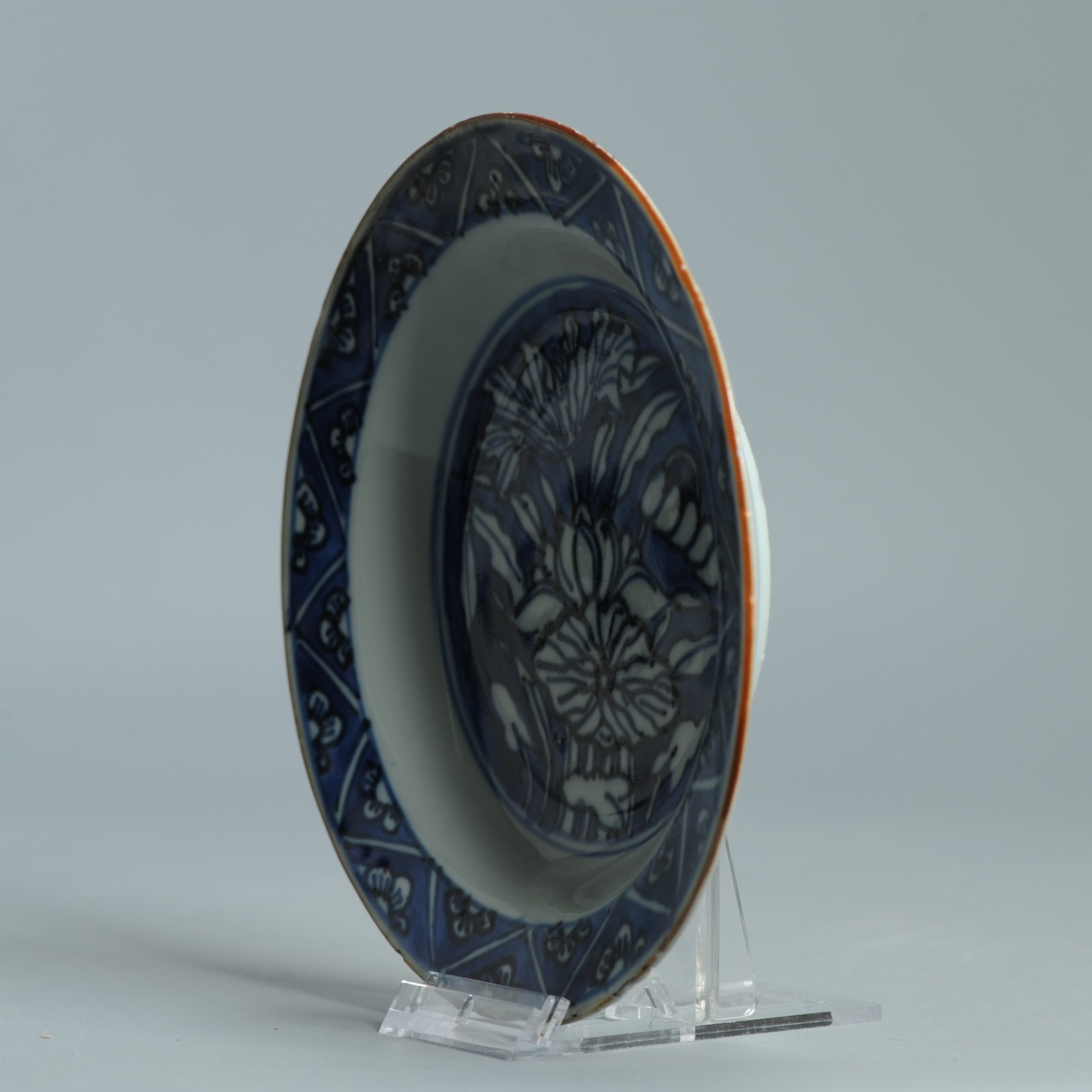


Antique Ming 1620-1644 Chinese Porcelain Kosometsuke Reverse Decorated Plate
无货
Condition Report: No hairlines, no restorations, just some typical rimfritting. Size: 14.5x2.7CM DiameterxHeight
Early 17th Century Chinese Kosometsuke Porcelain Dish – Late Ming, ca. 1620 – Floral Design
A fine and bold example of a Kosometsuke porcelain dish, made in Jingdezhen for the Japanese market during the late Ming Dynasty. This beautifully potted small dish is painted in deep cobalt blue under a clear glaze, with strong contrasts and typical Japanese tea ceremony appeal. Striking central floral design, reverse decorated, likely representing lotus and peony blooms with leaves and curling stems. The border features a radiating pattern of triangular panels, each filled with repeated flower motifs, in a vivid dark blue.
The reverse with symbols in the wall, the base has a sealmark fu within a double square
Details:
-
Date: Early 17th century, late Ming Dynasty
-
Origin: Jingdezhen, China
These pieces were highly valued in Japanese tea culture and remain sought after by collectors of Chinese export porcelain today.
Blue & White
At its core, Chinese blue and white porcelain is made by painting designs with a blue pigment from cobalt oxide onto white clay, which is then glazed and fired at high temperatures. But the story behind these iconic pieces is much more interesting than just the process.
Blue and white ceramics have a special place in China’s long and rich pottery tradition. The signature blue first became popular during the Tang dynasty (618–907), but it was in the Yuan dynasty (1279–1368), when China was under Mongol rule, that the techniques really evolved into what we now think of as classic blue and white porcelain.
Thanks to the thriving Silk Road trade, cobalt ore was brought in from Persia. It was incredibly rare and expensive, so artisans used it sparingly — which is one of the reasons why early blue and white pieces are so valuable and sought after by collectors today.
The craftsmen of the Yuan dynasty took immense pride in their work, often adding mythological or spiritual elements. A great example is the famous Yuan charger featuring a mythical creature, now in the Ashmolean Museum in Oxford (collection number EAX.1707).
For centuries, Chinese blue and white porcelain has been treasured around the world, often given as diplomatic gifts or reserved for special occasions.
——————————————————————————————————————
Important information
Auction
We start an auction every week, a nice opportunity to buy pieces for good prices;
https://www.ebay.com/str/antiquefromshangrila?LH_Auction=1
Combined shipment
We combine shipment and have over 2500 fixed listings in store, always good to
take a look if you see other items you like to save some shipping and mother nature:
https://www.ebay.com/usr/theceramics_and_collectibles
All will be packed neat and sent track and trace and insurance. Registered airmail.
Packages are always shipped on the next wednesday.
If there is a specific hurry please contact us.
Offers
All fixed items are open for offers, please feel free to make an offer and we will
respond as soon as possible.
Payment
Payment of items should be done within 5 days after the auction ends, or update us
on later payment. It’s all about good communication.
——————————————————————————————————————
Additional Information
| 重量 | 4 公斤 |
|---|---|
| Type | |
| Primary Material | |
| Region of Origin | |
| China Dynasty Period | |
| Century | |
| Material | |
| Condition Report | No hairlines, no restorations, just some typical rimfritting. Size: 14.5×2.7CM DiameterxHeight |
| Emperor |

